
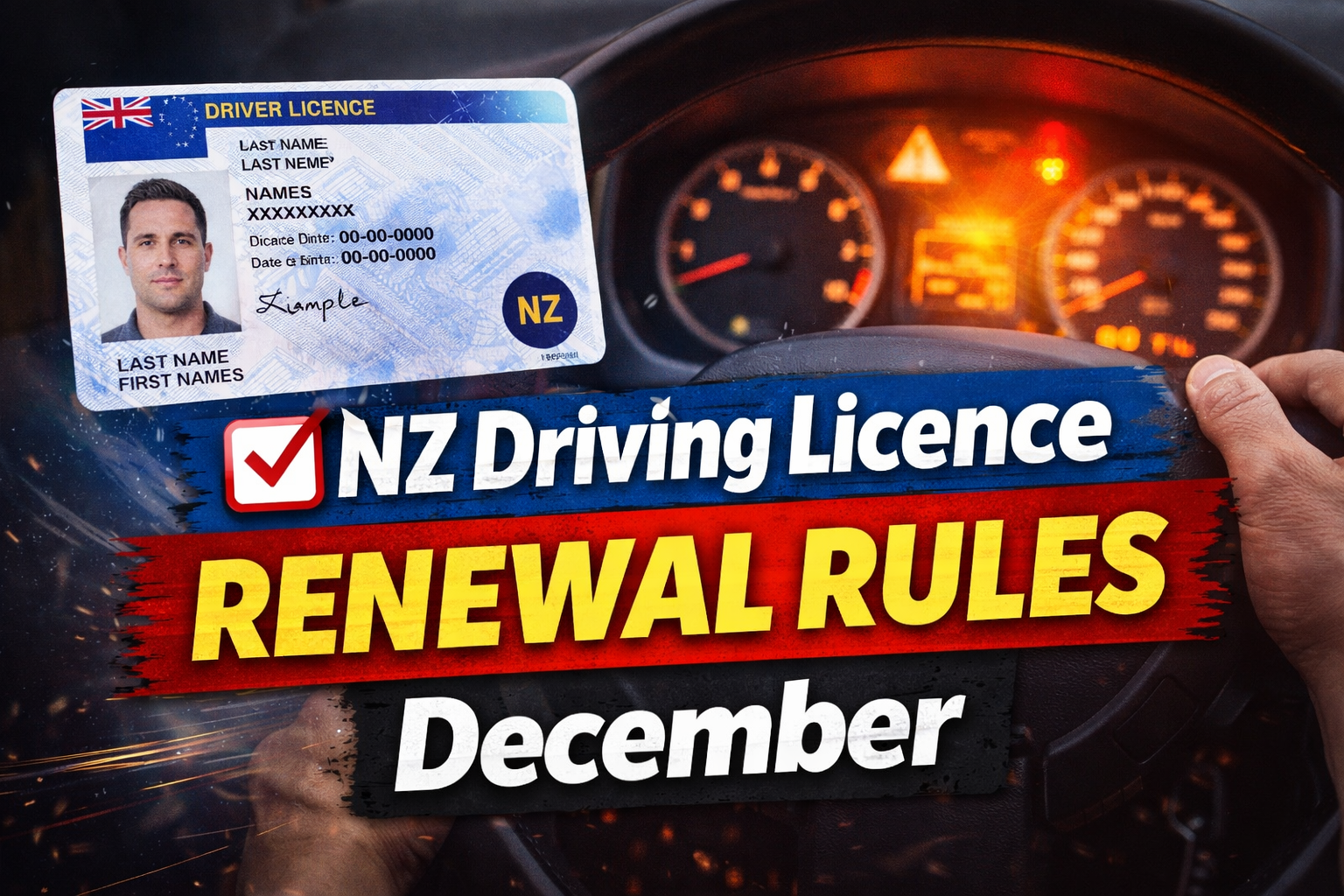
New Zealand’s driving licence renewal rules for older motorists are entering a new phase in December 2025, with the government introducing administrative updates designed to improve safety while reducing unnecessary inconvenience for senior drivers. Although the core age-related renewal checkpoints remain unchanged, several operational adjustments, digital submission options, and medical-assessment clarifications are now being rolled out nationally.
These changes particularly affect drivers aged 65 and older, including those nearing the critical renewal milestones at 75, 80, and every two years thereafter. The government’s stated objective is to strike a balance between public road safety and the mobility needs of New Zealand’s ageing population.
This article provides a comprehensive analysis of all updates, practical renewal steps, medical requirements, timelines, and the new 2025 procedures every senior driver should know.
Why New Zealand Updates Older-Driver Rules
New Zealand’s demographic trends show that adults aged 65 and above represent one of the fastest-growing age groups. An increasing proportion of these older adults continue to drive actively for work, caregiving, community involvement, and daily independence.
Policy adjustments focus on three core principles:
- Ensuring that drivers maintain the physical and cognitive capability required for safe road use.
- Providing clear, streamlined administrative processes to reduce confusion for senior drivers.
- Allowing clinicians to identify medical risks early and suggest appropriate licence conditions.
Vision changes, medication side-effects, and age-related health conditions are key factors prompting regular assessment. However, the government emphasises that most seniors continue driving safely well into their 70s and 80s, and the renewal system aims to support—not restrict—them.
What Has Changed in December 2025
While the legal renewal ages have not changed, the processes and documentation requirements have been updated. Key changes include:
- Streamlined medical certificate submissions, with expanded digital lodgement options for clinics that choose to participate.
- Revised medical assessment forms allowing health professionals to provide more specific fitness-to-drive recommendations.
- Improved renewal reminders sent earlier and with clearer instructions.
- Updated guidelines for vision checks, allowing recognised optometrists to submit digital results directly.
- Simplified renewal forms for seniors whose personal details have not changed since their last renewal.
These improvements are primarily administrative, designed to shorten queues, reduce repeated visits to licensing agents, and prevent incomplete applications.
Importantly, there is no new rule requiring everyone aged 65–74 to renew more frequently. Standard ten-year renewals still apply unless a medical condition requires earlier review.

Who Is Affected by the December 2025 Rules
Three groups of drivers experience the most impact:
Drivers aged 65–74
This group does not face new renewal timelines. However, they will notice:
- More detailed health questions on standard forms.
- Stronger recommendations to undergo voluntary vision checks.
- Earlier and clearer postal and digital reminders.
Drivers turning 75
This age remains the first mandatory medical certificate checkpoint. Drivers must provide:
- A medical certificate completed within the permitted time window.
- Any supporting documentation suggested by their clinician.
- A new photograph and standard identification documents.
Drivers aged 80 and above
After turning 80, licences must be renewed every two years, each time requiring a medical assessment. These drivers will benefit most from the improved digital medical submission options.
Step-by-Step Process for Seniors Renewing Licences in December 2025
The table below clearly outlines what senior drivers need to do based on their age and upcoming renewal period.
Renewal Process Table
| Step | Applies to | Details |
|---|---|---|
| Check renewal reminder | All senior drivers | Reminders are now sent earlier and include QR codes linking to correct forms. |
| Schedule medical assessment | 75+, or younger if required | Must be recent; clinicians now have updated assessment templates. |
| Complete vision check | Recommended for all 65+ drivers | Digital submissions allowed where optometrists participate. |
| Prepare documents | All renewers | Includes existing licence, ID, address confirmation, and renewal form. |
| Visit licensed agent or complete hybrid process | Most seniors | Some steps can be digital, but all renewers still require identity verification. |
| Pay renewal fee | All drivers | Fees vary by class; senior medical renewals typically incur the standard processing cost. |
Updated Medical and Functional Requirements
The clinical evaluation process has been enhanced to ensure assessments are consistent nationwide. The medical certificate now includes:
- Vision screening: distance and near acuity, peripheral fields, and night-vision review.
- Cognitive function indicators: attention, judgment, memory, and decision-making.
- Mobility and reaction time checks: assessing how medical conditions may impact vehicle control.
- Medication review: with emphasis on sedatives, cardiovascular drugs, diabetes medications, and treatments causing dizziness.
- Cardiovascular or neurological conditions: more detailed reporting requirements for recent strokes, seizures, dizziness, or heart failure.
Clinicians can now recommend:
- Unrestricted driving
- Driving with licence conditions (daylight-only, geographic limits, corrective lenses, automatic-only)
- Referral to an occupational therapist or specialist
- A practical on-road assessment
- Temporary driving cessation
- Permanent cessation when safety risks are severe
These structured categories are intended to improve safety decisions while creating fair, transparent outcomes for older drivers.
What to Expect at the Licensing Agent
When seniors visit the licensing agent, the process generally includes:
- Verification of identity and personal details.
- Submission of the medical certificate (unless already digitally submitted).
- A new licence photo and signature.
- Review of any new licence conditions recommended by clinicians.
- Payment of standard renewal fees.
- Issuance of a temporary licence while processing is completed.
Agents also provide brochures outlining local mobility services and support programmes for seniors transitioning away from driving.
New Support Measures for Older Drivers
New Zealand’s transport framework recognises that driving is essential for independence. Therefore, alongside administrative updates, new support measures have been strengthened in 2025:
Community-based driver support
Local councils and senior organisations are expanding:
- Voluntary refresher driving courses
- Hazard-awareness training
- Workshops on updated road rules
- Mobility-transition counselling
Health system support
Clinicians receive revised national training materials to ensure consistency when completing medical assessments.
Transport alternatives
Regions increasingly provide:
- Community shuttle services
- Discounted taxi vouchers for seniors
- Public-transport concession passes
- Shared mobility services designed for older adults
These resources are highlighted during licence renewal discussions.
Addressing Common Misconceptions in 2025
Confusion online has led to several myths about the December 2025 rules. Below are the clarifications:
- Myth: All seniors over 65 must renew every two years.
Fact: Renewal checkpoints remain at 75, 80, and every two years from 80 onward. - Myth: The government is removing licences from older drivers.
Fact: The system supports safe driving; most seniors continue to renew successfully. - Myth: Seniors must take a mandatory on-road test.
Fact: On-road tests occur only when a clinician or the licensing authority requests them. - Myth: Digital renewals eliminate the need to visit an agent.
Fact: Identity verification still requires an in-person component.
How Families Can Support Senior Drivers
Families are encouraged to participate in the renewal journey, especially where age-related health concerns are present. Best-practice recommendations include:
- Attending medical appointments with the driver.
- Reviewing renewal reminders together.
- Discussing realistic driving patterns, such as reducing night driving.
- Assisting with transport alternatives if driving becomes unsafe.
- Helping seniors understand new digital procedures and online forms.
A proactive, supportive approach helps prevent stress and misunderstandings during the renewal process.
Preparing for Licence Changes in the Coming Years
Although no major legislative overhaul has been announced for 2026–2030, transport officials continue to review international road-safety data and demographic trends. Potential future developments under consideration include:
- Broader adoption of digital identity verification.
- More specialised medical assessment pathways for cognitive impairment.
- Optional telehealth components for non-critical renewal checks.
- Enhanced mobility-transition support for seniors who stop driving.
These areas remain exploratory but signal a long-term commitment to evolving the system responsibly.
Practical Tips for a Smooth Renewal
Senior drivers renewing their licence in December 2025 should consider the following:
- Book medical checkups early, especially during holiday months when clinics are busy.
- Bring a support person if the renewal process feels overwhelming.
- Double-check all documents before arriving at the licensing agent.
- Use digital tools when possible to reduce time spent in queues.
- Review new road rules introduced in 2024 and 2025, particularly around speed zones and roundabout priority.
- Stay updated by checking official communications rather than relying on social media information.
Preparedness is the most effective way to ensure a stress-free renewal.
Conclusion
New Zealand’s December 2025 driving licence renewal rules for seniors reaffirm the country’s commitment to safe, independent mobility for its ageing population. While the essential renewal ages of 75, 80, and every two years after 80 remain unchanged, the process has been modernised with clearer forms, digital enhancements, and stronger clinical assessment tools.
These improvements are designed to streamline operations without imposing unnecessary burdens on senior drivers. Most older New Zealanders will find the new system easier to navigate, more informative, and more supportive than previous versions.
With early preparation, proper medical documentation, and awareness of the updated procedures, seniors can continue driving confidently and safely throughout 2025 and beyond.





Leave a Comment